MPI Semantics
Overview
Tutorial: 20 min
- Objectives:
Learn the semantics of MPI.
To help us understand and better use MPI, we get into the details of its semantics. Fair warning ahead, this is a bit of a dry topic and it does get tedious. You can skip this section if you just want pick up MPI functions and use them straightaway, but recommend you to go through this section to acquire a more in-depth understanding of MPI.
We discuss the semantics of MPI with the structure illustrated in the following diagram:
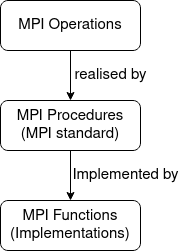
MPI Operations
First, we introduce the concept of MPI operations.
Definition
An MPI operation is a sequence of steps performed by the MPI library to establish and enable data transfer and/or synchronishation. It consists of four stages: initialisation, starting, completion, and freeing. An MPI operation is implemented as a set of one or more MPI procedures.
The main MPI operations are: Blocking Operations, Non-blocking Operations, Collective Operations, and Persistent Operations. We will discuss each of these in detail in the upcoming sections.
Note
An MPI operation describes the property of a class of data transfer mechanism but does not define a unique MPI procedure.
The four stages of an MPI operation are:
initialisation: Hands over the argument list to the operation but not the content of the data buffers.
starting: Hands over the control of the data buffers, if any, to the associated operation.
completion: Returns control of the content of the data buffers and indicates that output buffers and arguments, if any, have been updated.
freeing: Returns control of the rest of the argument list.
We can apply these stages to define the four aforementioned MPI operations.
Definition
A blocking operation is when the four stages are combined into a single procedure call.
An example is the blocking send operation is the MPI procedure MPI_SEND.
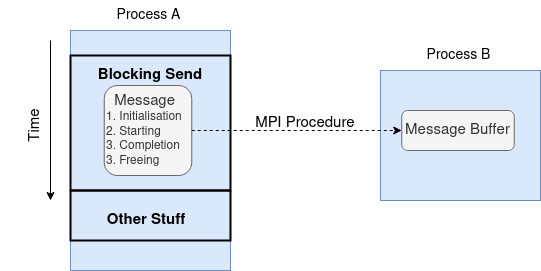
The send operation is blocking at process A.
Definition
A non-blocking operation is when the the initialisation and starting stages are combined into a single nonblocking procedure call, and the completion and freeing stages are combined into another single procedure call.
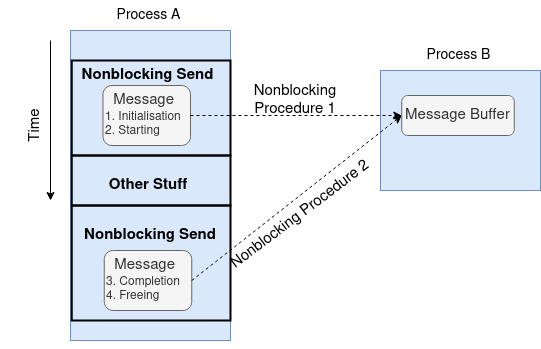
The send operation is non-blocking at process A.
Definition ::class: hint
A persistent operation is when there is a single procedure for each of the four stages of the operation.
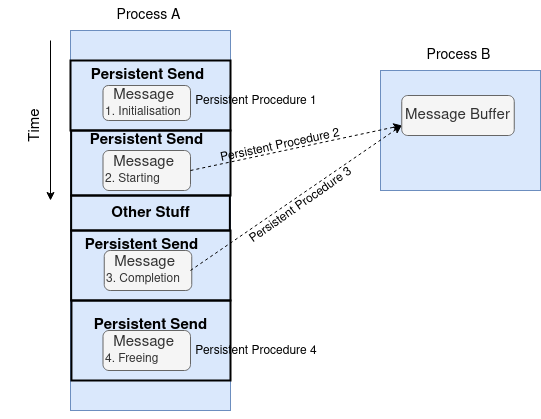
The send operation is persistent at process A.
MPI Procedures
We now understand the MPI operations are realised by MPI procedures, we can formally introduce the concept of MPI procedures.
Definition
An MPI procedure describes functionalities and are specified using a language-independent notation. An MPI operation-related procedure implements at least a part of stage of an MPI operation.
Example
MPI_SEND, MPI_PROBE
There for more than 400 MPI procedures in MPI Standard 4.0. We use all capital letters to denote MPI procedures, e.g., MPI_SEND.
Note
All MPI procedures can either be local or non-local, depending on whether its completion requires calls on another MPI process.
An MPI operation can be realised by different MPI procedures. For example, a block send operation can be realised by different mode such as MPI_SEND, MPI_SSEND, MPI_BSEND, and MPI_RSEND.
MPI Functions
Definition
An MPI function is a language-specific binding of an MPI procedure. It is a function that can be called from a program written in a specific language, e.g., C, Fortran.
Example
MPI_Send, MPI_Probe
Note that to distinguish betwee MPI procedure and MPI function, the MPI functions use lower case.
We summarise the semantics with two diagrams:
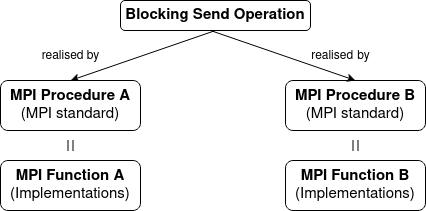
Blocking send operation realised by two different MPI procedures
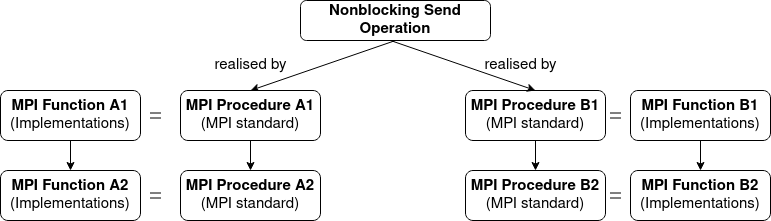
Non-blocking send operation realised by two different groups of MPI procedures, each group consists of two MPI procedures.