The Basic MPI calls
Overview
Tutorial: 20 min
- Objectives:
Learn six monstly used MPI calls.
MPI can be very easy to use. If your code only needs simple communication patterns, such as point-to-point communication, you can get by with just six MPI calls. These six calls are:
MPI_Init: Initializes the MPI environment.
MPI_Comm_size: Returns the total number of processes in a communicator.
MPI_Comm_rank: Returns the rank of the calling process in a communicator.
MPI_Send: Sends a message to a specific process.
MPI_Recv: Receives a message from a specific process.
MPI_Finalize: Terminates the MPI environment.
Key MPI call
MPI_INIT()
C Binding:
int MPI_Init(int &argc, char &argv)
Note
The MPI_Init() call does not create a process; rather, it initialises the MPI environment, e.g. defines the initial communicator MPI_WORLD_COMM.
It must be called before any other MPI function.
Communicator
As we saw in the our first MPI call MPI_Init(), MPI uses a communicator to define a group of processes that can communicate with each other.
Note
The communicator defines the group of processes for communication.
A communicator must be specified in MPI program as a unit of communication. The default communicator is MPI_COMM_WORLD, which includes all processes.
Multiple communicators can be defined, either overlapping or non-overlapping.
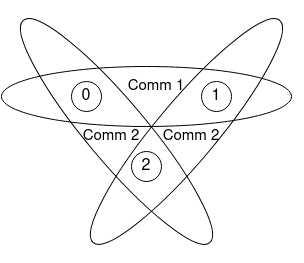
Caption: Overlapping communicators between three processes
Basic Communication Management
The basic communication management in MPI is done using the following functions:
Key MPI call
- MPI_COMM_SIZE(comm, size)
IN comm: communicator (handle)
OUT size: number of processes in the group of comm (integer)
C Binding:
// determine the number of processes in the group of comm
int MPI_Comm_size(MPI_Comm comm, int *size)
Key MPI call
- MPI_COMM_RANK(comm, rank)
IN comm: communicator (handle)
OUT rank: rank of the calling process in group of comm (integer)
C Binding:
// determine the rank of the calling process in the group of comm
int MPI_Comm_rank(MPI_Comm comm, int *rank)
“Close” MPI process
Once the MPI program has completed its work, it is important to close the MPI environment. This is done using the MPI_Finalize() function.
Key MPI call
MPI_FINALIZE() C Binding:
int MPI_Finalize()
Note
MPI_Finalize() cleans up the MPI environment and should be called after all other MPI functions have been called.
However, it does not shut down the processes.
Behaviour could be undefined if called on a process that still participates in communication.
Consider using MPI_Abort for error capture.
Combining the basic MPI calls, we can write summarise a MPI program in the following structure:
#include<stdio.h>
#include <mpi.h>

int main(int argc, char *argv[]) {
    int rank, size;
    MPI_Init(&argc, &argv);
    double start_t, end_t;
    start_t =  MPI_Wtime();
    MPI_Comm world = MPI_COMM_WORLD;
    MPI_Comm_size(world, &size);
    MPI_Comm_rank(world, &rank);


    /* main body of code */

    end_t = MPI_Wtime();
    printf("MPI program runtime = %f at rank %d\n", end_t - start_t, rank);
    MPI_Finalize();
    return 0;
}
Exercise
Review the given program MC_pi.c to understand the structure of a basic MPI program.