Collective Communication
We have seen a bundle of point to point communication in the previous section. Despite the various modes and behaviours of the communication, the basic idea is the same: a message is sent from one process to another. In this section, we discuss collective communication, which involves multiple processes. The collective communication can be further divided into: All to All, One to All, and All to One communication.
Definition
All to All All processes contribute to the result. All processes receive the result.
All to One All processes contribute to the result. One process receives the result.
All to One One process contributes to the result. All processes receive the result.
In our example, we need the collective communications for quantities such as the averaging the errors, or the max or min of the function values defined over the domain.
One to all Communication
MPI_BCAST MPI_BCAST broadcasts a message from the process with rank “root” to all other processes of the communicator, as shown in the figure below.

In this diagram, each row of the box represents data location in one process. Initially only the first process contain the data A0, after the MPI_BCAST call, all processes contain the data A0.
Key MPI call
- MPI_BCAST(buffer, count, datatype, root, comm)
INOUT buffer: initial address of send buffer (choice) IN count: number of elements in send buffer (non-negative integer) IN datatype: data type of elements in send buffer (handle) IN root: rank of broadcast root (integer) IN comm: communicator (handle)
C Binding:
// broadcast a message from the process with rank "root" to all other processes of the communicator
int MPI_Bcast(void *buffer, int count, MPI_Datatype datatype, int root, MPI_Comm comm)
All to One Communication
MPI_REDUCE MPI_REDUCE combines the data from all processes, operate on them by a predefined operator, and returns the result to one process. The figure below shows the operation of MPI_REDUCE.
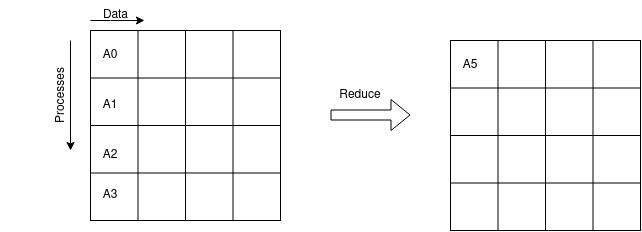
In the diagram above, a global reduce operation performs across all members of the communication group, and returns the result of the reduction to one member of the group.
Key MPI call
- MPI_REDUCE(sendbuf, recvbuf, count, datatype, op, root, comm)
IN sendbuf: address of send buffer (choice) OUT recvbuf: address of receive buffer (choice, significant only at root) IN count: number of elements in send buffer (non-negative integer) IN datatype: data type of elements in send buffer (handle) IN op: operation (handle) IN root: rank of root process (integer) IN comm: communicator (handle)
C Binding:
// combine the data from all processes, operate on them by a predefined operator, and return the result to one process
int MPI_Reduce(void *sendbuf, void *recvbuf, int count, MPI_Datatype datatype, MPI_Op op, int root, MPI_Comm comm)
In our example, we use MPI_REDUCE to calculate the global l2 residual.
/* get local residual from each process */
double residual, tot_res;
residual  = local_l2_residual(ptr_rows, mesh_size, space, &submesh[0][0], \
subrhs[0][0]);

/* sum res from all processes and calculate l2 norm */
MPI_Reduce(&residual, &tot_res, 1, MPI_DOUBLE, MPI_SUM, 0, MPI_COMM_WORLD);
if (rank == 0){
    tot_res = sqrt(tot_res);
    printf("Residual1  %f\n",  tot_res);
    }
Note
MPI standard provides a set of predefined operators.
MPI_MAX: maximum
MPI_MIN: minimum
MPI_SUM: sum
MPI_PROD: product
MPI_MAXLOC: max value and location
MPI_MINLOC: min value and location
7. and a few more bit-wise operators User-defined reduction operations are also possible.
All to All Communication
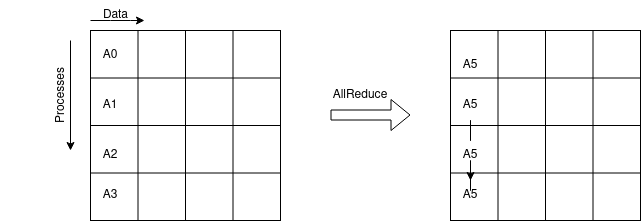
MPI_ALLREDUCE MPI_ALLREDUCE` is similar to MPI_REDUCE, but the result is returned to all processes. Effectively, it is the same as MPI_REDUCE + MPI_BCAST. The figure below shows the operation of MPI_ALLREDUCE.
Key MPI call
- MPI_ALLREDUCE(sendbuf, recvbuf, count, datatype, op, comm)
IN sendbuf: address of send buffer (choice) OUT recvbuf: address of receive buffer (choice) IN count: number of elements in send buffer (non-negative integer) IN datatype: data type of elements in send buffer (handle) IN op: operation (handle) IN comm: communicator (handle)
C Binding:
// combine the data from all processes, operate on them by a predefined operator, and return the result to all processes
int MPI_Allreduce(void *sendbuf, void *recvbuf, int count, MPI_Datatype datatype, MPI_Op op, MPI_Comm comm)
Remark
The collective communication procedures MPI_REDUCE, MPI_ALLREDUCE, MPI_BCAST are blocking operations.
There are corresponding non-blocking procedures for each of them following the same deinition of the nonblocking operation that we discussed before.
There are also corresponding persistent procedures for each of them following the same definition of the persistent operation that we discussed before.